I-10 Corridor Freight:
The Western Lanes,
Mile by Mile.
Markets, transit math, cargo theft exposure and dry van capacity from Southern California to South Texas — plus a checklist to use before you book a 53-foot dry van.
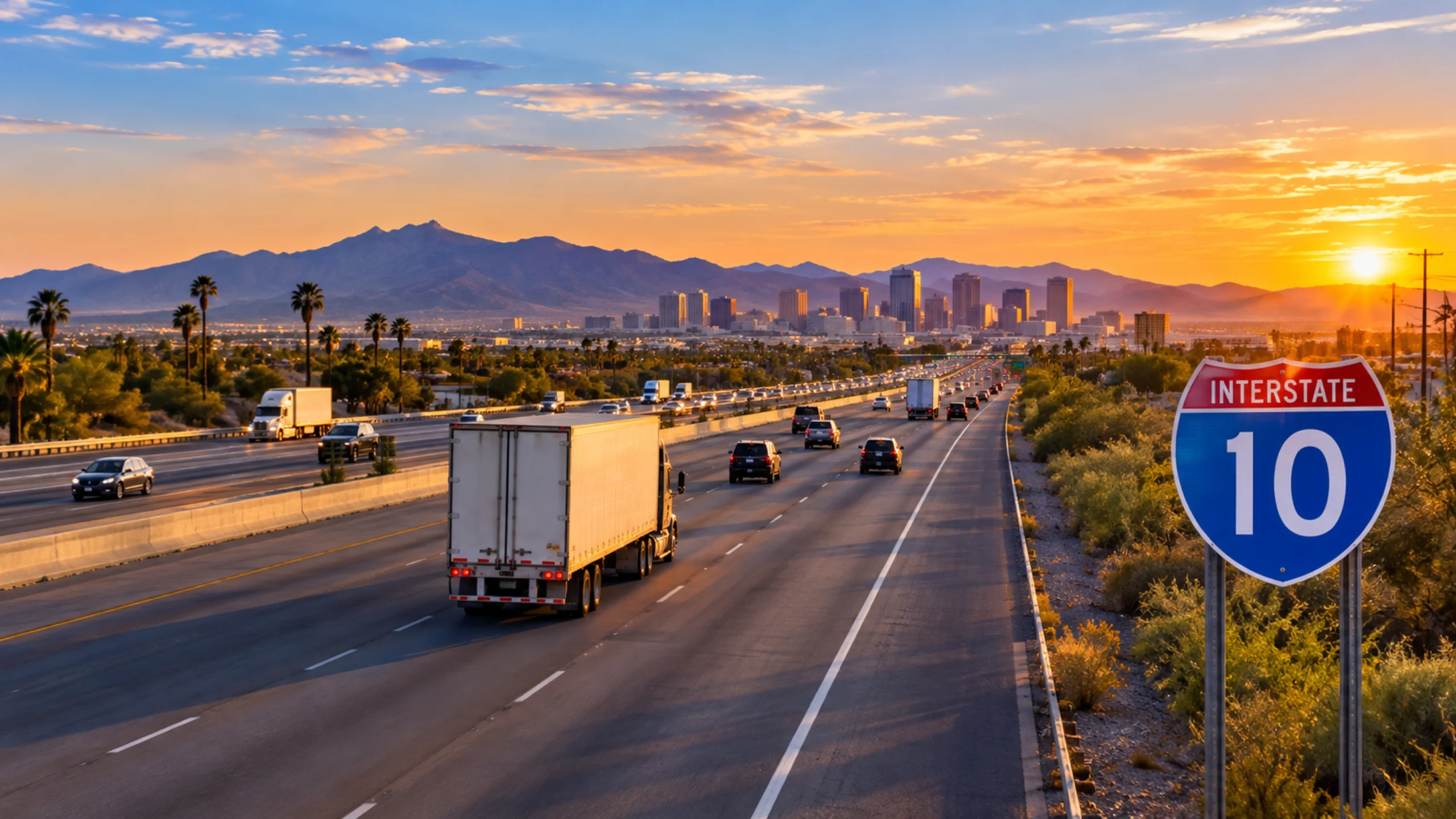
If you ship I-10 corridor freight, you’re using the primary trucking route between the Port of Long Beach and central Texas, according to the Arizona Department of Transportation. On a map, it’s one straight line. On a load board, it’s several lanes stitched together, each with its own capacity, theft exposure and driving-time math.
This guide covers the western half of the corridor, from Southern California through Arizona and El Paso to South Texas. You’ll find the markets that matter, a simple way to estimate transit, where the security risk concentrates, and a checklist to use before you book a 53-foot dry van.
Key takeaways
- Western I-10 links six freight markets, from the Los Angeles ports to South Texas, and each one tightens for different reasons.
- Transit is set by hours-of-service rules. A solo driver typically covers about 500 to 550 miles a day.
- California and Texas accounted for 58% of reported U.S. cargo thefts in 2025, so security belongs in the booking decision.
- Dry van capacity is tight heading into Q4 2026, which favors shippers who tender early.
What is the I-10 corridor for freight?
The I-10 corridor is the freight lane built around Interstate 10, the southernmost coast-to-coast highway in the United States. It runs roughly 2,400 miles from Santa Monica, California, to Jacksonville, Florida. Texas holds the longest piece, about 880 miles from the New Mexico line near El Paso to the Louisiana border, according to TxDOT’s I-10 Texas Corridor Study.
What turns the highway into a freight corridor is what it connects. TxDOT describes I-10 as the only east-west interstate that links border crossings in the West with the major Gulf Coast ports in the East. Along the way, I-10 corridor freight ties Southern California port traffic to Arizona distribution, the El Paso–Juárez border region, and the San Antonio and Houston metros.
Shippers usually treat it as two halves:
- Western I-10: Southern California through Arizona and El Paso to South Texas. Shorter hauls, heavy border and distribution traffic, and the focus of this guide.
- Eastern I-10 and the coast-to-coast run: Houston through the Gulf states into Florida. For the full picture on that longer move, see our breakdown of Los Angeles to Miami FTL rates and transit times.
Which markets matter on western I-10?
Western I-10 corridor freight concentrates in six markets: Los Angeles and the Inland Empire, San Diego, Phoenix, Tucson, El Paso and South Texas. Each one feeds the corridor for a different reason, from port imports to Mexican border crossings to regional distribution. Knowing why a market generates freight tells you when its capacity is likely to tighten.
- Los Angeles / Inland EmpireWestern end of I-10, port import flow
- PhoenixI-17 junction, warehousing
- Casa Grande areaI-8 from San Diego joins I-10
- TucsonI-19 from Nogales joins I-10
- El PasoI-10 enters Texas, Juárez crossings
- San Antonio areaI-35 junction, South Texas freight
| Market | How it connects to I-10 | What drives its freight |
|---|---|---|
| Los Angeles / Inland Empire | Western end of I-10 | Port of Long Beach and Los Angeles import flow heading east |
| San Diego | Joins via I-8, which meets I-10 near Casa Grande, Arizona | Coastal and border-region distribution |
| Phoenix | I-17 junction | DAT has described it as the Southwest’s largest warehouse market |
| Tucson | I-19 from the Nogales port of entry meets I-10 here | Cross-border produce and goods moving north from Mexico |
| El Paso | I-10 enters Texas here | The El Paso–Juárez region, the second-largest binational metro on the U.S.–Mexico border, per TxDOT |
| South Texas (San Antonio area) | I-35 junction in San Antonio | Central and South Texas production and distribution |
One practical takeaway: the western half is a string of origins and destinations, not just a pass-through. A load from Southern California to South Texas can pick up or drop in Arizona or El Paso without leaving the corridor. That’s why multi-stop planning and a carrier’s history on the lane matter here.
How long does freight take on the I-10 corridor?
Transit on I-10 is set by federal hours-of-service rules, not by distance alone. Under FMCSA’s hours-of-service regulations, a property-carrying driver can drive up to 11 hours after 10 consecutive hours off duty, and cannot drive past the 14th hour after coming on duty. In normal highway conditions, that works out to roughly 500 to 550 miles a day for a solo driver.
That daily range is a planning estimate, not a regulatory number. It assumes steady highway speeds and no long waits at the dock.
Here’s a practical way to build a realistic estimate for any I-10 corridor freight load:
- Get the lane miles from your carrier or routing software, including any stops in Arizona or El Paso.
- Divide by 500 to 550 to get solo driving days.
- Add pickup and delivery time. Loading, unloading and the required 30-minute break after 8 hours of driving all count against the day.
- Protect the 14-hour window. Detention at the shipper burns the driver’s clock, since off-duty time doesn’t extend the 14 hours. Two hours waiting at the dock can mean two fewer hours on the road.
- Ask about team drivers for time-critical, long runs. Two drivers alternating can keep a truck moving while one rests.
For scale, ADOT puts the Los Angeles to Houston stretch at about 1,700 miles. By the math above, that’s three or more solo driving days before any dock time.
Is the I-10 corridor a high-risk route for cargo theft?
Yes, and it’s worth planning for. Both ends of western I-10 sit in the two states with the most cargo theft in the country. California and Texas accounted for 58% of the 2,576 U.S. cargo thefts Overhaul recorded in 2025, as reported by FreightWaves, with activity clustered around Los Angeles, San Bernardino, Dallas and Houston.
- California and Texas combined
- Rest of the U.S.
Losses are also growing. Verisk CargoNet estimated 2025 cargo theft losses at nearly $725 million, up 60% from 2024, with an average theft value of $273,990. California logged 1,218 incidents on its own, more than any other state.
Three patterns matter most for I-10 corridor freight:
- Risk follows the interstate. Overhaul’s head of intelligence told FreightWaves that thefts had spread along I-10 and I-40 through Arizona, New Mexico and Texas in recent years.
- Full trailers are a Texas concern. In Overhaul’s Q2 2025 data, Texas accounted for 56% of full-truckload thefts, according to Supply Chain Digest.
- Stops are the weak point. CargoNet lists warehouses, distribution centers and truck stops among the most targeted locations.
The pattern has continued into 2026. Overhaul counted 605 reported cargo thefts in Q2 2026, with California and Texas still the top hot spots, according to FreightWaves.
Steps that reduce the risk on a dry van load
- Verify the carrier’s operating authority and insurance in FMCSA’s SAFER system before tender, not after pickup.
- Confirm driver identity and equipment at the dock. Treat last-minute carrier swaps or new email addresses as red flags.
- Seal the trailer, record the seal number on the BOL, and require tracking from pickup to delivery.
- Plan fuel and rest stops so a loaded trailer isn’t left unattended at a truck stop.
For a closer look at how fraud rings get loaded trailers, see these cargo theft scam tactics. You can also review the carrier vetting and risk management protocol GLT applies before any load moves.
What’s happening with dry van capacity right now?
Dry van capacity is tight heading into Q4 2026, mainly because trucks are leaving the market rather than because freight is booming. In DAT’s weekly dry van report, van equipment posts were 25.8% below a year earlier while load posts were up 29.7%, pushing the load-to-truck ratio to 11.40.
For I-10 corridor freight, the western end is the one to watch: California posted the strongest weekly gain among top origins at $2.49 a mile. DAT’s 35-day forecast puts national dry van spot near $2.14 a mile by late October.
What this means for I-10 corridor freight:
- Direction changes the price. Outbound Southern California freight typically costs more than the reverse move. We explain the headhaul and backhaul logic in why California-to-Florida freight rates turned volatile.
- A thin market favors early tendering. When capacity exits, the carriers still taking spot loads can be selective. Loads tendered the day before pickup compete for whatever is left.
- Low price and strong vetting rarely arrive together in a tight week. The lowest spot offer on a high-theft corridor deserves a closer look, not less of one.
Checklist: booking a 53-foot dry van on I-10
Before you tender I-10 corridor freight, confirm six things: the lane miles and stops, a transit estimate built on hours-of-service math, the carrier’s verified authority and insurance, the carrier’s history on this corridor, your security steps at pickup, and a tender date that leaves room in a tight market.
- Stops and miles. List every pickup and drop, including any Arizona or El Paso stop, and confirm total lane miles.
- Transit estimate. Use the hours-of-service math above and share realistic appointment windows with your consignee.
- Carrier verification. Check authority and insurance in FMCSA’s SAFER system, and confirm the carrier you tendered to is the one that shows up.
- Lane history. Ask whether the carrier runs this corridor regularly. A carrier that knows the lane prices it with fewer surprises.
- Security at the dock. Seal, record, track, and agree on where the driver will stop in the first hours of the trip.
- Lead time. Tender early in weeks when DAT shows capacity tightening. The best-prepared carriers book first.
If a provider can’t give clear answers on items 3 through 5, it’s reasonable to keep comparing options before you commit the load.
Frequently asked questions about I-10 corridor freight
Where a lane-specific carrier network helps
Everything above gets easier when the carriers moving your I-10 corridor freight already know the lane. GLT Logistics runs dry van FTL on two I-10 lanes: Los Angeles to Miami, and Nixon, Texas, to the Los Angeles area, with capacity for stops in El Paso, Phoenix, Tucson and San Diego. Carriers on both lanes clear the same vetting protocol before dispatch. You can see how the service works on our full truckload services page.
Ready to Move Your Dry Van on I-10?
Shipping a 53-foot dry van on I-10 this quarter? Send us the lane, dates and stops, and we’ll come back with a rate for the Los Angeles to Miami or Nixon to Los Angeles corridor.
No commitment. Just a real conversation about your freight.