Your freight doesn’t care about federal regulations until a driver gets pulled out of service and your delivery window disappears. That’s exactly what’s happening at roadside inspections across the Southern border right now, and it’s changing how shippers need to vet the carriers who move their Mexico freight.
The FMCSA English proficiency rule isn’t new, but strict enforcement is. Since the agency reinstated strict roadside checks, inspectors have pulled thousands of drivers off the road under 49 CFR § 391.11(b)(2), and the numbers are concentrated almost entirely in the states your cross-border freight actually moves through.
This guide breaks down what the rule requires, where the border zone exemption applies and doesn’t, what the data says about where violations are happening, and what shippers and freight forwarders should be asking their carriers before the next load rolls.
What the FMCSA English Proficiency Rule Actually Requires
FMCSA requires every commercial driver operating in interstate commerce to speak and read English well enough to converse with the public, understand highway signs, respond to official inquiries, and complete reports. Roadside inspectors assess this under internal policy MC-SEE-2026-0002, using a two-step process that can place a driver out of service on the spot.
The Two-Step Roadside Test
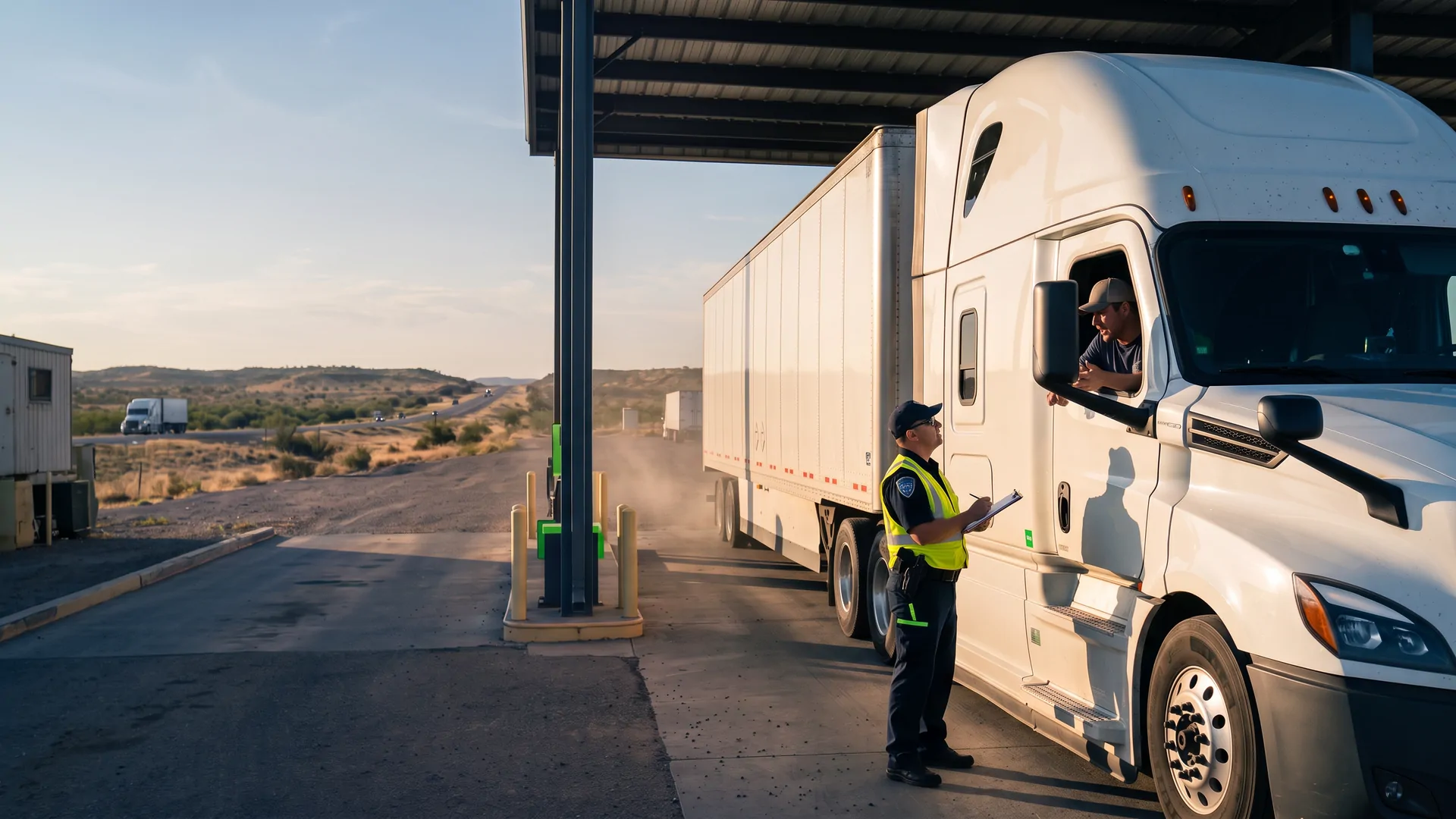
An inspector’s assessment happens in two parts. Step one is a direct conversation: can the driver respond sufficiently to questions about their trip, logs, and cargo? If the driver cannot clear step one, the inspector skips step two entirely — the standard portion where drivers identify highway signs — and cites the violation directly.
This matters because step one is subjective in a way step two isn’t. A driver who understands English well enough to drive safely but struggles under the pressure of a roadside interview can still fail. That’s part of why industry groups, including the Commercial Vehicle Safety Alliance, have pushed FMCSA for clearer guidance over the past year.
Why Enforcement Changed in 2025
The rule itself dates back decades, but FMCSA treated ELP violations as a citation, not an out-of-service event, for years. That changed when the agency reinstated strict enforcement and began hard-coding out-of-service designations into its SafeSpect inspection system on June 25, 2025, through three violation codes: 391.11B2Q, 391.11B2S, and 391.11B2Z.
The Border Commercial Zone Exemption, Explained
FMCSA carved out an exemption for drivers working entirely inside defined U.S.-Mexico border commercial zones. Inspectors still cite the ELP violation, but they do not place the driver out of service if the current trip stays inside the zone. The exemption applies regardless of the driver’s or carrier’s country of domicile.
Which Counties and Zones Are Covered
The zones are defined in 49 CFR Part 372, Subpart B. Municipal border zones range from 3 to 20 miles depending on the city’s population. FMCSA’s guidance also names Cameron, Hidalgo, Starr, and Willacy counties in Texas, the City of El Paso, and the New Mexico commercial zones as covered areas.
On October 6, 2026, FMCSA updated its public FAQ for the third time since February, adding a question that clarifies which drivers fall outside the policy altogether — including certain agricultural and custom-harvesting operations exempted under separate rules. The guidance has moved fast: February 3, April 16, and October 6, all in the same year.
What Happens If a Driver’s Trip Leaves the Zone
The exemption is trip-specific, not driver-specific. A driver who fails the ELP assessment while working a short drayage move entirely inside the El Paso commercial zone keeps rolling. The same driver, on a load that continues north out of that zone, gets placed out of service immediately. If your freight is headed to a distribution center outside the border region, this distinction is the one that actually affects your transit time.
Drayage moves that stay inside the border commercial zone and long-haul legs that continue into the U.S. interior are functionally different trips under this rule, even when the same truck and driver are involved. Carriers who separate these legs cleanly, and staff them with drivers who clear both steps of the assessment, carry less compliance risk for the freight riding with them.
Why Border-State Carriers Account for Most ELP Violations
Of the 48,213 ELP violations logged in 2025, Texas, New Mexico, Arizona, and California together accounted for 68.4% — and Texas alone accounted for 57.2% nationally. Nearly 60% of all ELP violations nationwide were logged specifically inside a Southern border commercial zone, which is exactly where most Mexico cross-border freight changes hands.
| State | Share of that state’s ELP violations logged inside a border commercial zone |
|---|---|
| Texas | 88.4% |
| Arizona | 75% |
| California | 74% |
| New Mexico | 57.7% |
The concentration makes sense operationally. These are the states where the highest volume of drivers cross daily, where drayage and transloading happen inside the commercial zones, and where FMCSA has focused inspection staffing. DOT reported in August 2026 that more than 26,000 commercial drivers have been placed out of service nationwide for ELP violations since strict enforcement resumed, with the 10,000 out-of-service milestone reached back in December 2025.
What This Means for Shippers and Freight Forwarders
A carrier’s driver getting pulled out of service mid-route doesn’t just delay one load — it can strand a truck, force a same-day driver swap, and blow through your delivery appointment. For freight that crosses out of the border commercial zone, a carrier’s ELP compliance history is now a real operational risk factor, not a paperwork detail.
This is where shipper and forwarder due diligence matters more than it used to. A carrier that primarily handles short drayage moves inside the border zone may have a different risk profile than one that regularly runs long-haul legs from the border into the U.S. interior — and that second move is exactly where the exemption stops applying.
- Does the driver assigned to this load handle both the border-zone leg and the long-haul leg, or does the carrier swap drivers at the border?
- What is the carrier’s ELP out-of-service history over the past 12 months?
- Does the carrier own the equipment and vet its own drivers, or does it broker the load to a third party?
- Is the carrier CTPAT-certified, and does that certification come with documented driver vetting?
- Who do you call if a driver is placed out of service mid-route, and how fast does that carrier typically respond?
How to Vet a Cross-Border Carrier Under the New Enforcement Rules
Vetting a cross-border carrier now means asking about driver assignment practices, not just rates and transit times. The carriers with the least exposure to ELP out-of-service risk are the ones that know exactly where the border commercial zone ends and staff their long-haul legs accordingly, rather than treating the whole route as one undifferentiated move.
Ask prospective carriers how they structure the handoff between the border-zone leg and the U.S. interior leg. Some carriers run separate crews for each segment precisely because of rules like this one. Others don’t distinguish at all, which raises the odds that a driver qualified for a short zone move ends up on a load that continues well past it.
Our carriers only work drivers who are vetted personally before they’re assigned a route, and our bilingual team tracks compliance issues like this one as part of normal carrier management — not as a reaction after a load gets delayed. Our Mexico cross-border service separates drayage and long-haul legs by design, which is part of why we can tell you, before you book, which leg of your route carries the most compliance exposure.
Carrier compliance issues like ELP enforcement rarely show up in a quote — they show up at a scale house, three states into a route your customer is already tracking. GLT has run freight across the U.S.-Mexico border for more than two decades, working only with carriers who own their trucks and get evaluated personally before they touch a load. Our Mexico freight transportation service is built around exactly this kind of regulatory exposure, with a bilingual team that catches it before it reaches your delivery window.
FAQ — FMCSA English Proficiency Rule
Ready to Simplify Your Mexico Freight?
Talk directly with a logistics expert who knows Mexico cross-border compliance from the ground up — not a chatbot, not a junior rep.
No commitment. Just a real conversation about your freight.