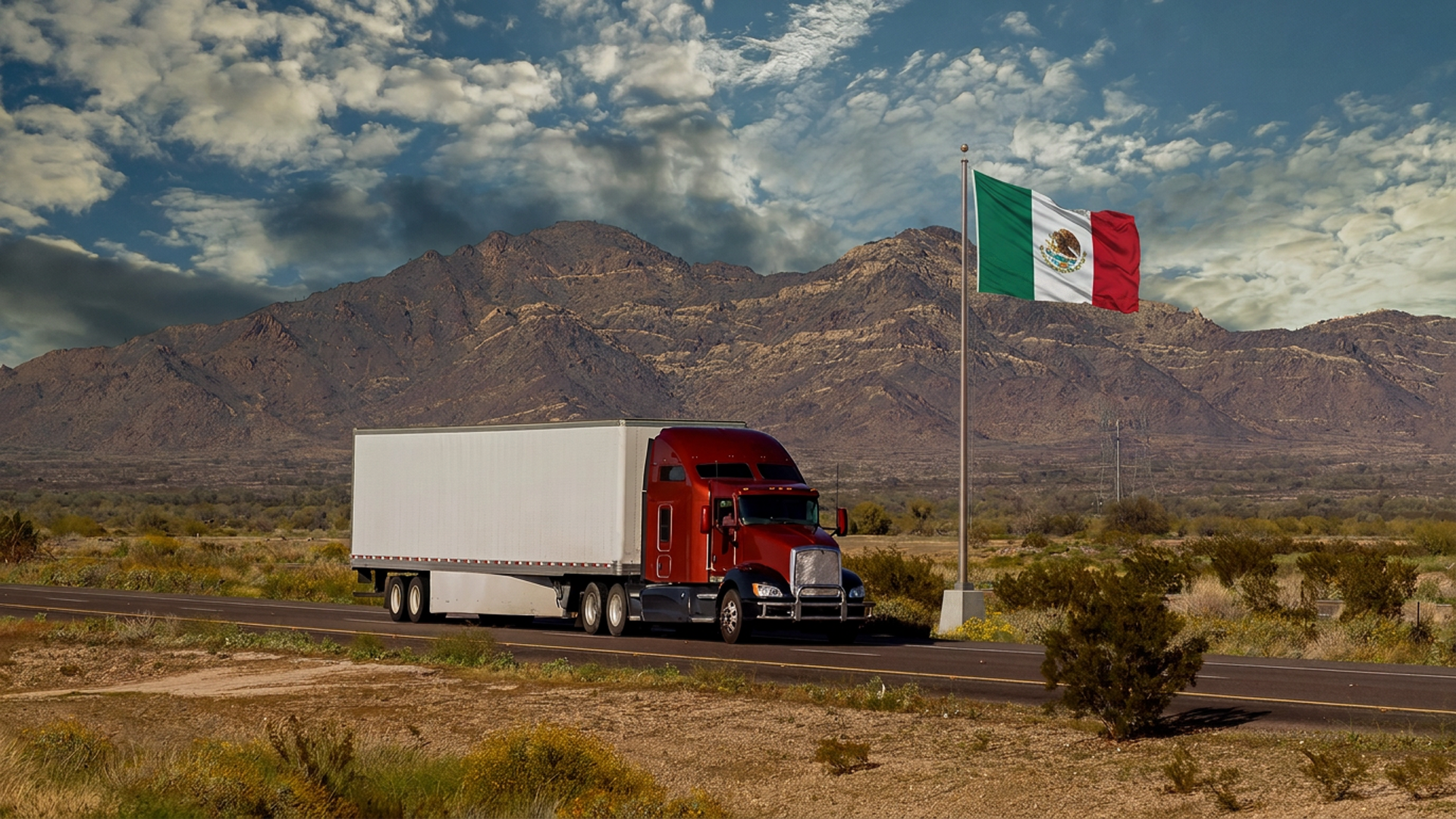
Mexico Cross-Border Shipping
Documentation: A Practical Guide.
A reference guide to the documents, broker roles, and border process behind every U.S.–Mexico shipment — for freight forwarders, U.S. shippers, and supply chain teams running these lanes today.
Mexico cross-border shipping documentation is owned by a licensed customs broker — the agente aduanal — not by the carrier or the freight forwarder. Missing or inconsistent paperwork is the single most common reason cargo gets held at the border, in either direction, and under the 2026 Customs Law Reform the financial exposure has increased materially.
For freight forwarders running U.S.–Mexico lanes, documentation is where most border delays begin. The trucks are usually ready. The carriers are scheduled. The crossing itself takes minutes when everything is in order. It’s the paperwork — missing registrations, inconsistent descriptions between documents, expired sectoral permits — that holds freight at the line for hours or days.
This guide walks through the documents commonly required for Mexico cross-border shipping, who is responsible for each one, and how the border process actually works in both directions. Requirements vary based on commodity, trade lane, and applicable agreements, so always confirm specifics with your licensed customs broker before a shipment moves.
Why Cross-Border Shipping Documentation Causes Border Delays
Documentation is the single most controllable variable in cross-border freight, and the most consistently mishandled. A red-light inspection at the border can be triggered by a description that doesn’t match between the commercial invoice and the packing list, a lapsed RFC registration, or a missing entry in the Padrón Sectorial for a regulated commodity.
The cost of a Cross-Border Shipping Documentation is the single most controllable variable, and the most consistently mishandled. A red-light inspection at the border can be triggered by a description that doesn’t match between the commercial invoice and the packing list, a lapsed RFC registration, or a missing entry in the Padrón Sectorial for a regulated commodity. The error is rarely just the paperwork fix. The cargo sits. Storage fees accrue. Downstream delivery commitments slip. Temperature-sensitive freight starts losing margin against its cold-chain budget. And under the 2026 Customs Law Reform, the financial exposure has expanded: fines for non-compliance can reach up to 300% of the value of the goods, and repeat Carta Porte violations can trigger penalties of up to roughly $112,650 MXN under Article 83-VII of the Federal Fiscal Code. Freight forwarders running these lanes smoothly are not necessarily the ones with the fastest carriers — they’re the ones whose documentation is correct, complete, and consistent before the truck leaves the origin.
Who Is Responsible for Cross-Border Shipping Documentation — and Who Isn’t
The licensed customs broker — agente aduanal, often abbreviated AA — is the only party legally responsible for confirming that all required documentation is current and complete before a cross-border shipment clears. Carriers don’t do this. Freight forwarders don’t do this. The customer’s traffic team provides the inputs, but the broker owns the compliance verification.
This is worth stating clearly because it’s where new operators most often get confused. The broker is licensed and authorized to file customs entries on behalf of the importer or exporter — that’s what the Delegated Order, covered below, formally authorizes. For freight forwarders building or expanding a Mexico lane, the broker relationship is foundational.
The customs broker (agente aduanal) is the only one who must confirm with the customer that all required documents are up to date.
One important update under the 2026 Customs Law Reform: the previous exemption that placed sole liability for value declarations on the broker has been eliminated. For value-related declarations specifically, importers and customs agents now share direct liability. The broker still owns documentation verification overall, but value declarations are now a jointly accountable area — a change worth raising with your broker partners on new lanes.
Required Documents for U.S.–Mexico Cross-Border Freight
The following documents are commonly required for Mexico cross-border shipping. The customs broker will confirm which apply to a specific shipment based on commodity, direction, and applicable trade agreements.
Document 01
Federal Taxpayer Registry (RFC)
The RFC — Registro Federal de Contribuyentes — is Mexico’s taxpayer identification number, equivalent in function to a U.S. EIN. Any party engaged in commercial activity in Mexico needs one. When presenting information to a customs agent for a border crossing, the importer or exporter must indicate whether they are acting as an individual (persona física) or a legal entity (persona moral). That designation changes how the customs entry is filed.
Document 02
Sectoral Exporter/Importer Registry (Padrón Sectorial)
The Padrón Sectorial is a specialized registration required for regulated commodities listed in Annex 10 of Mexico’s General Foreign Trade Rules (RGCE). The 2026 framework covers 16+ specific sectors, periodically updated by SAT. Categories that come up frequently on cross-border freight lanes include alcoholic beverages, cigarettes and tobacco, energy drinks, iron ores, textiles and apparel, footwear, hydrocarbons and fuels, steel products, automotive, plastics, rubber, wood and paper, glass, aluminum, chemical products, firearms and explosives, and precursors. The full current list is published in Annex 10 of the RGCE 2026.
Document 03
Commercial Invoice
The commercial invoice identifies the seller and buyer of the goods and establishes the declared value of the transaction. Customs authorities on both sides of the border use it to assess duties and verify that the transaction is accurately described. A complete commercial invoice includes the names and addresses of buyer and seller, an itemized description of goods, quantity and unit of measure, unit price and total, currency, and country of origin. Vague descriptions — “spare parts,” “industrial goods,” “merchandise” — are one of the most common triggers for secondary review. Be specific.
Document 04
Delegated Order (Carta de Encomienda)
The Delegated Order formally notifies Mexico’s Tax Administration Service (SAT) that customs brokers are authorized to process goods on behalf of the exporting or importing company. Without this authorization, the broker cannot legally act in the customer’s name at customs.
Document 05
Customs Entry Document (Pedimento)
The Pedimento is the official customs entry document filed by the customs broker with Mexican customs authorities. It confirms that all applicable contributions to the Treasury have been accounted for in connection with the entry or exit of goods — the customs declaration that legally clears the cargo for crossing. It is prepared and filed by the broker, not by the shipper or freight forwarder.
Document 06
Customs Broker Instruction Letter
The Customs Broker Instruction Letter provides the broker with the specific operational instructions needed to correctly perform the customs clearance for a given shipment. It translates the customer’s intent into actionable guidance — covering classification, valuation, and any special handling conditions.
Document 07
Packing List
The packing list provides an itemized breakdown of the physical contents of the shipment — item descriptions, quantities, weights, and package dimensions. Customs agents use it to verify that what is physically present matches what was declared on the commercial invoice and Pedimento. Discrepancies between the packing list and the actual cargo, even small ones, are one of the most consistent triggers for inspection.
Document 08
Certificate of Origin
A Certificate of Origin is used to obtain preferential treatment by establishing that goods qualify under an applicable trade agreement. The specific contents vary based on the destination country and may include tariff classification, exporter information, and a declaration of origin. Under USMCA, the certification has no specific government-issued form, but it must include a set of minimum data elements specified in the agreement. The U.S. Customs and Border Protection USMCA implementation page is the authoritative reference for U.S.-side requirements.
July 2026 review update: USMCA’s first mandatory joint review took place on July 1, 2026, six years after the agreement took effect. The United States confirmed it did not agree to renew USMCA in its current form, while Mexico and Canada each confirmed they wanted to extend it for the full 16-year term. The agreement has not lapsed — it remains fully in force — but the parties now move into a cycle of annual joint reviews until all three agree to an extension. For freight forwarders, the practical effect for now is continuity: existing certifications remain valid and rules of origin are unchanged. But expect rules of origin — particularly for automotive, electronics, and goods with non-North American inputs — to stay a live topic through the coming reviews. Confirm with your broker that any Certificate of Origin on file still reflects current requirements before each shipment; this certificate also determines your exposure to the tariff layers covered in Section 04 below.
Document 09
Transportation Document
The transportation document specifies the mode of transport, confirms delivery expectations, and identifies the place of delivery. For cross-border freight moving by truck, this is typically the bill of lading or Carta Porte.
Document 10
Complemento Carta Porte
The Complemento Carta Porte is a legal document that certifies the presence and ownership of goods or merchandise while they are in transit within Mexican national territory. It is issued together with a digital tax receipt — the Comprobante Fiscal Digital por Internet (CFDI) — and is a SAT requirement for ground transport within Mexican territory. For freight forwarders coordinating U.S.–Mexico moves, it primarily affects the Mexican carrier’s compliance — but if the carrier is non-compliant, the cargo can be stopped and detained inside Mexico, so its status directly affects shipment reliability. The official reference is the SAT Carta Porte portal.
Document 11
Non-Tariff Regulations (NOMs / RyRNAs)
Certain commodities require additional documentation to demonstrate compliance with Mexico’s non-tariff regulations and restrictions (RyRNAs) — aimed at controlling the flow of specific goods across borders. These may include permits, health certificates, phytosanitary certificates, or compliance with Normas Oficiales Mexicanas (NOMs). If the product category is regulated — food, electronics, chemicals, medical devices, cosmetics — the customs broker will identify the applicable NOMs and ensure the supporting documentation is in order before the shipment moves.
Document 12 — New 2026
Manifestación de Valor (Electronic Value Manifestation)
The Manifestación de Valor — the customs value declaration — is a long-standing obligation under Mexican customs law that documents the declared value of imported goods and its supporting elements. What changed in 2026 is the submission method: under the Customs Law Reform and Rule 1.5.1 of the RGCE 2026, it must be transmitted electronically through VUCEM (Mexico’s Digital Single Window) before customs clearance.
SAT has pushed this deadline back three times since the original December 2025 date. The most recent extension (published July 31, 2026) moved the transition period through September 30, 2026, meaning electronic transmission via VUCEM becomes fully enforceable from October 1, 2026. Given the pattern of extensions, confirm the current status with your broker before assuming the deadline has held. Supporting documents that travel with the MV include invoices, contracts, payment records, INCOTERMS evidence, and any value adjustments. Penalties for inaccurate, missing, or late data vary by violation type — figures range from a few thousand pesos for late corrections up to six figures for undetermined value cases — and shared liability between importer and broker now applies. Confirm the applicable amount for your case directly with your broker, since SAT has revised these figures more than once in 2026. The official reference is the SAT customs portal.
Document 13
Operation Document for Customs Dispatch (DODA)
The DODA — Documento de Operación para Despacho Aduanero — is the final step before cargo crosses. Once the Pedimento is validated and paid, the customs broker generates the DODA: a unified document with an integrated QR code, digital SAT seal, and the broker’s electronic signature. It replaces the printed Pedimento at the customs module. This is the document that actually triggers the semáforo fiscal — Mexico’s automated selection mechanism. The transportista presents the DODA’s QR code at the customs module; the system scans it and determines, on the spot, whether the cargo is released or flagged for physical inspection. The red-light outcome referenced throughout this guide is decided at the moment the DODA is scanned, not before.
Tariffs, Duties, and Why Your Certificate of Origin Is a Cost Lever in 2026
Documentation and tariff exposure are no longer separate conversations. U.S. imports from Mexico currently sit under a multi-layer tariff stack — and whether a shipment qualifies under USMCA is what determines which layers actually apply. Rates on this lane have changed multiple times in 2026, so treat the figures below as a working framework and confirm current rates with your broker before quoting a landed cost.
| Layer | Rate | Applies to USMCA-qualifying goods? |
|---|---|---|
| Section 232 (steel & aluminum) | 50% steel/aluminum, 25% derivative products | Yes — applies regardless of USMCA status |
| Section 232 (autos) | 25% | Yes, subject to the 75% North American content rule |
| Section 301 (forced-labor duty) | 10–12.5%, subject to a 150-day statutory cap | No — USMCA-qualifying goods are exempt entirely |
| MFN / standard duty | Varies by HTS classification | No — USMCA-qualifying goods enter duty-free on this layer |
The Section 122 surcharge replaced the IEEPA tariffs the U.S. Supreme Court struck down on February 20, 2026 (Learning Resources, Inc. v. Trump). It took effect February 24, 2026, and carries a 150-day statutory cap under the Trade Act of 1974 — meaning it’s built to expire or be renewed on its own timeline, not to run indefinitely. In parallel, USTR opened two Section 301 investigations on March 11, 2026 that could establish a successor tariff structure once Section 122 lapses. Whether Mexico is included, and at what rate, is still an open question — particularly given the U.S.’s decision not to renew USMCA in its current form at the July 1, 2026 joint review. The practical takeaway: don’t assume today’s Section 122 rate is the rate you’ll pay next quarter. Check with your broker before locking in a landed-cost estimate on any new lane.
Every layer in the stack above except Section 232 turns on one thing: whether the shipment carries a valid USMCA Certificate of Origin with accurate rules-of-origin data. A shipment that fails to qualify — because the self-certification is incomplete, the regional value content wasn’t actually met, or the classification is wrong — doesn’t just risk a red-light inspection. It pays the applicable Section 301 duty on top of MFN duty. The Certificate of Origin has gone from a compliance formality to one of the largest single cost levers on this lane.
One adjacent program worth knowing about if you work with manufacturers: IMMEX (Industria Manufacturera, Maquiladora y de Servicios de Exportación) lets a Mexican-registered manufacturer temporarily import raw materials, components, and machinery without paying Mexican import duties or VAT upfront, provided the finished goods are exported within an authorized window (18 months for inputs). It’s a Mexican-side program, separate from the U.S. tariff stack above, but it’s frequently in play on the same shipments — a maquiladora bringing in U.S.-origin components under IMMEX, then exporting the finished product back north under USMCA. If your freight regularly crosses under an IMMEX program, confirm with your broker how the temporary-import declaration interacts with the Pedimento and Manifestación de Valor on that leg.
Choosing a Border Crossing: Laredo, El Paso, and Otay Mesa
Which crossing you route through isn’t just geography — it affects broker availability, transfer-yard capacity, and how much slack you have on a bad day. Three crossings handle roughly two-thirds of all U.S.–Mexico truck freight.
| Crossing | Best for | Operating notes |
|---|---|---|
| Laredo, TX (World Trade Bridge) | Bajío manufacturing (Querétaro, Guanajuato, San Luis Potosí) and general freight | The busiest land port in the hemisphere — over 38% of inbound truck traffic from Mexico. Deepest pool of brokers, carriers, and transfer yards; the most forgiving crossing on a bad day. |
| El Paso / Ysleta, TX | Ciudad Juárez / Chihuahua manufacturing | Second-busiest crossing. Strong for maquiladora traffic out of Juárez; Eagle Pass serves as a relief lane when El Paso backs up. |
| Otay Mesa, CA | Tijuana / Baja California freight headed to Southern California | Purpose-built commercial port with dedicated truck lanes, separate from passenger traffic, plus FAST lanes for pre-approved CTPAT shipments. The natural gateway for West Coast-bound freight. |
The overwhelming majority of commercial shipments change hands at the border, regardless of crossing — a standard Mexican operating authority doesn’t extend into the U.S. interior, and a standard U.S. authority doesn’t extend into Mexico. (A small number of carriers hold special long-haul cross-border authority, but it’s the exception, not the default, and comes with its own audit and monitoring requirements.) For most shipments, that’s why the broker’s warehouse or the carrier’s transfer yard — covered in the next two sections — exists at every one of these crossings, not just as a convenience, but as a structural part of how the lane works.
The USA → Mexico Cross-Border Process
For freight moving from the United States into Mexico, the customer must work with a customs broker who is physically present at the border. That broker handles the inspection of the cargo and completes the cross-border shipping documentation. In many cases, this broker acts as both the U.S. and Mexican broker — a single point of contact for both sides.
The broker typically operates a warehouse near the crossing where cargo is staged while customs clearance is processed.
This is why broker proximity matters operationally. A broker who is not physically present at your crossing creates a structural delay risk that no amount of paperwork preparation can offset. The same principle applies to the freight forwarder’s own coverage — having someone reachable in the right timezone and language is the difference between a fix that happens in hours and one that happens in days.
The Mexico → USA Cross-Border Process
For freight moving from Mexico into the United States, the arrangement is different. The customer typically needs two brokers: a Mexican customs broker with a border presence, and a U.S. customs broker who may operate remotely.
The carrier holds the cargo at the border in the carrier’s yard for up to two free days while documents are finalized for the U.S. entry. If the shipment is flagged for inspection or documentation review, the Mexican customs broker must go to the customs module where the cargo is located to manage the inspection or resolve the issue in person — same as in the U.S.-to-Mexico direction.
Comparing Cross-Border Shipping Documentation by Direction
| Aspect | USA → Mexico | Mexico → USA |
|---|---|---|
| Broker structure | Single broker often handles both sides | Mexican broker (at border) + U.S. broker (often remote) |
| Cargo staging | Broker’s warehouse near the crossing | Carrier’s yard at the border |
| Free hold period | Varies — confirm with broker | Up to two days while U.S. entry is finalized |
| Red-light response | Broker goes to customs module in person | Mexican broker goes to customs module in person |
| Required documents | RFC, Pedimento, commercial invoice, packing list, Delegated Order, Instruction Letter, Certificate of Origin, Complemento Carta Porte, Manifestación de Valor (electronic from August 2026), DODA, NOMs if applicable | Same core set, with Mexican-side export documentation and U.S. entry filing |
Common Cross-Border Shipping Documentation Errors That Cause Border Holds
Across U.S.–Mexico lanes, the same documentation issues come up repeatedly. The patterns below cause the majority of avoidable delays.
The most consistent issue we see is inconsistency between the commercial invoice and the packing list — vague descriptions, mismatched quantities, missing country of origin. Every other document can be in order, but that one inconsistency is enough to trigger a red light at the border.
Juan OlarteMexico Country Manager, GLT Logistics
-
RFC mismatches or lapsed registrations
If the RFC on file doesn’t match the entity presenting at customs, or the registration has expired, the broker cannot file. Verify RFC status before shipment.
-
Vague descriptions on the commercial invoice
“Industrial parts” or “merchandise” trigger review. Be specific and consistent across invoice, packing list, and Pedimento.
-
Packing list discrepancies
Physical count, weight, or description that doesn’t match documentation. Minor discrepancies can escalate to a red-light scenario.
-
Missing Padrón Sectorial registration
Regulated commodities will not clear without the appropriate sectoral registration. This is often the first thing to verify when a new commodity is added to a lane.
-
Certificate of Origin errors
Incorrect tariff classification or missing self-certification language can result in the importer paying full duties instead of preferential rates under USMCA — or the shipment being flagged.
-
Complemento Carta Porte non-compliance by the carrier
If the Mexican carrier’s CFDI complement isn’t in order, the cargo can be detained inside Mexico by SAT authorities even when the customer’s own documentation is perfect. CTPAT-certified carriers with strong compliance discipline are worth seeking out for this reason.
-
Manifestación de Valor not transmitted via VUCEM
From October 1, 2026, the electronic Value Manifestation must be uploaded to VUCEM before clearance. Importers have a maximum of two days to complete the upload before the submission expires. Inaccurate or missing data triggers penalties that scale with the violation, confirmed case by case with your broker.
Pre-Shipment Checklist for U.S.–Mexico Cross-Border Freight
Before a shipment moves, there’s a defined set of items to confirm with your broker, your carrier, and your own traffic team. We’ve packaged the full checklist as a downloadable PDF so freight forwarders and shipping teams can use it on every load.
Cross-Border Shipping Documentation Checklist
A practical, one-page reference used by freight forwarders and shipping teams running U.S.–Mexico lanes. Built from the documentation patterns that most commonly cause border holds, and turned into a quick check you can run on every load. Delivered as a PDF to your corporate inbox.
- Catch documentation gaps before pickup
- Reduce red-light inspections at the border
- Align your team, your broker, and your carrier
- Standardize cross-border prep across every load
We’ll email the PDF to the address you provide. No spam — just the Cross-Border Shipping Documentation checklist and an occasional operational brief from our team.
How Freight Coordinators and Customs Brokers Work Together
Coordinating a Mexico cross-border shipment involves two distinct operational roles that are often confused. The customs broker handles legal customs entry. The carrier-side logistics coordinator — typically a 3PL or freight forwarder — handles physical movement.
The customs broker manages Pedimentos, classification, compliance confirmation, and red-light response. The carrier-side coordinator handles carrier selection, scheduling, in-transit visibility, and communication between the customer, the broker, the carrier, and the consignee.
Both roles are necessary. Neither replaces the other. The freight forwarders running these lanes smoothly are the ones whose carrier coordination and customs broker communicate proactively — confirming documentation status before the truck moves, scheduling the broker’s availability around the crossing, and handling exceptions in real time. When the coordinator and broker share a timezone, a language, and a working relationship, the lane runs differently than when they don’t.
Your logistics ally on the ground in Mexico
GLT Logistics is one of the few 3PLs with on-the-ground teams in both Mexico and the United States, working in English and Spanish across the same lane. We are not a customs broker and do not provide customs brokerage services — that work belongs to a licensed agente aduanal. What we handle is the carrier-side coordination that runs alongside the broker: carrier selection from a CTPAT-certified network, border scheduling, in-transit visibility, route optimization, and direct communication when exceptions happen — including red-light scenarios where cargo is held while documentation is resolved.
For freight forwarders and U.S. shippers running U.S.–Mexico freight, the practical effect is fewer handoffs, faster responses, and a coordinator reachable in the right language at the right hour. After 23+ years on this lane, it’s the model we’ve found works.
Frequently Asked Questions About Cross-Border Shipping Documentation
What Cross-Border Shipping Documentation is required for Mexico?
The most commonly required Cross-Border Shipping Documentation include the RFC, commercial invoice, packing list, Pedimento, Delegated Order, Customs Broker Instruction Letter, Certificate of Origin, transportation document, Complemento Carta Porte, the electronic Manifestación de Valor (mandatory via VUCEM from August 2026), and the DODA generated by the broker to trigger the semáforo fiscal at crossing. Regulated commodities also require Padrón Sectorial registration and applicable NOM documentation. The licensed customs broker confirms the complete list based on the specific shipment.
Who is legally responsible for cross-border shipping documentation?
The licensed customs broker (agente aduanal) is the only party who must confirm with the customer that all Cross-Border Shipping Documentation is current and complete. This responsibility does not fall on the carrier, freight forwarder, or logistics coordinator, though those parties must supply accurate inputs to the broker.
What is a Pedimento?
The Pedimento is the official customs entry document filed by a licensed Mexican customs broker with Mexican customs authorities. It confirms that all applicable duties and contributions to the Treasury have been accounted for in connection with the entry or exit of goods. It is prepared and filed by the broker, not the shipper or freight forwarder.
Do I need a separate customs broker for each direction of the shipment?
For shipments entering Mexico from the U.S., a single broker with a physical border presence often handles both sides. For shipments moving from Mexico into the U.S., the more common arrangement is a Mexican broker with a border presence plus a U.S. broker, who may operate remotely. Confirm the setup with your broker before the first shipment moves.
What happens if my cargo receives a “red light” at the border?
A red light means the shipment has been flagged for inspection, either randomly or because of a documentation issue. The customs broker must go to the customs module where the cargo is located to facilitate the physical inspection or resolve the documentation problem in person. There is no remote resolution.
What is the Complemento Carta Porte and does it affect U.S. freight forwarders?
The Complemento Carta Porte is a legal document required by Mexico’s SAT that certifies the presence and ownership of goods in transit within Mexican territory. It is issued alongside a digital tax receipt (CFDI). It primarily applies to Mexican carriers, but non-compliance can cause cargo to be stopped and detained inside Mexico, which directly affects shipment reliability for freight forwarders coordinating the move.
What changed with Mexico’s 2026 Customs Law Reform?
Effective January 1, 2026, Mexico’s Ley Aduanera reform introduced the most significant changes to customs law in over a decade. The key updates are: mandatory electronic submission of the Manifestación de Valor via VUCEM (fully enforceable August 1, 2026), shared liability between importers and customs agents for value declarations, expanded electronic documentation requirements (Expediente Electrónico), and higher penalties for non-compliance — up to 300% of the value of goods. Importers and freight forwarders should align documentation workflows with their brokers ahead of full enforcement.
What happened at the USMCA joint review on July 1, 2026?
The USMCA Free Trade Commission held its first mandatory joint review on July 1, 2026. The United States did not agree to renew the agreement in its current form, while Mexico and Canada both confirmed they wanted to extend it for another 16 years. The agreement remains fully in force and has not lapsed — but the parties now enter a cycle of annual joint reviews until all three sides agree to an extension. Existing USMCA certifications and rules of origin remain valid for now; freight forwarders should keep monitoring this process with their broker.
What is the DODA and how does it relate to the “semáforo fiscal”?
The DODA (Documento de Operación para Despacho Aduanero) is the QR-coded document, generated by the customs broker once the Pedimento is validated and paid, that activates Mexico’s automated selection mechanism — the semáforo fiscal, or “fiscal traffic light.” Scanning the DODA at the customs module is what determines whether cargo is released or flagged for a red-light inspection.
Does USMCA still protect Mexican goods from U.S. tariffs in 2026?
Goods that qualify under USMCA rules of origin, backed by a valid Certificate of Origin, are exempt from the Section 301 forced-labor duty (10–12.5%) and enter free of standard MFN duty. They are not exempt from Section 232 tariffs on steel, aluminum, and autos, which apply regardless of USMCA status. A shipment that fails to properly qualify under USMCA loses that protection and pays the full applicable duty on top of standard MFN — which is why accurate Certificate of Origin documentation has become a direct cost issue, not just a compliance one.
Which border crossing should I use for U.S.–Mexico freight?
It depends on origin and destination. Laredo, Texas handles the largest share of U.S.–Mexico truck freight and is the strongest default for Bajío manufacturing regions and general freight. El Paso/Ysleta is the primary gateway for Ciudad Juárez and Chihuahua-area shipments. Otay Mesa, California is the natural choice for Tijuana and Baja California freight headed to Southern California, with dedicated commercial lanes and FAST processing for CTPAT-certified carriers. Together, these three crossings handle roughly two-thirds of all U.S.–Mexico truck crossings.
Need help with your Cross-Border Shipping Documentation?
Talk directly with a logistics expert who knows Mexico from the ground up — not a chatbot, not a junior rep.
No commitment. Just a real conversation about your freight.
This article covers Mexico Cross-Border Shipping Documentation Compliance. Requirements change and vary by commodity, trade lane, and applicable trade agreements. Always consult a licensed customs broker for guidance specific to your shipments. Published and fact-checked against current SAT/VUCEM regulations, July 2026.