
The logistics industry is navigating one of the most transformative chapters in its history. Recent immigration policies are reshaping the trucking landscape, directly impacting shippers’ and freight forwarders’ operations. This transition is no longer just about tracking spot rates. It’s about understanding the interplay between federal legislation, regulatory enforcement, and a tightening labor supply.
New policies, including the English Language Proficiency (ELP) mandate and stricter enforcement regarding non-domiciled CDLs (Commercial Driver’s Licenses), are expected to reduce the available driver workforce nationwide.
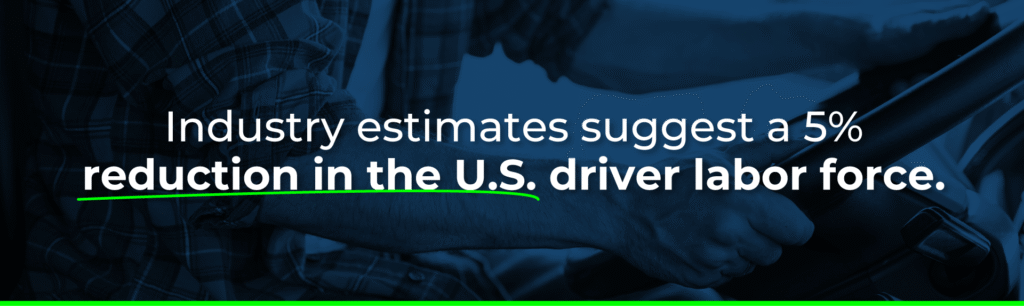
In a country where the foreign-born population accounts for 19.2% of the total U.S. civilian labor force (according to the Bureau of Labor Statistics), any shifts in immigration policies strike directly at the operational base of the transportation sector. In fact, industry estimates based on FMCSA data suggest these measures could reduce the driver labor force by roughly 5%, potentially sidelining up to 200,000 interstate drivers.
Here are the three policy shifts most directly affecting trucking capacity:
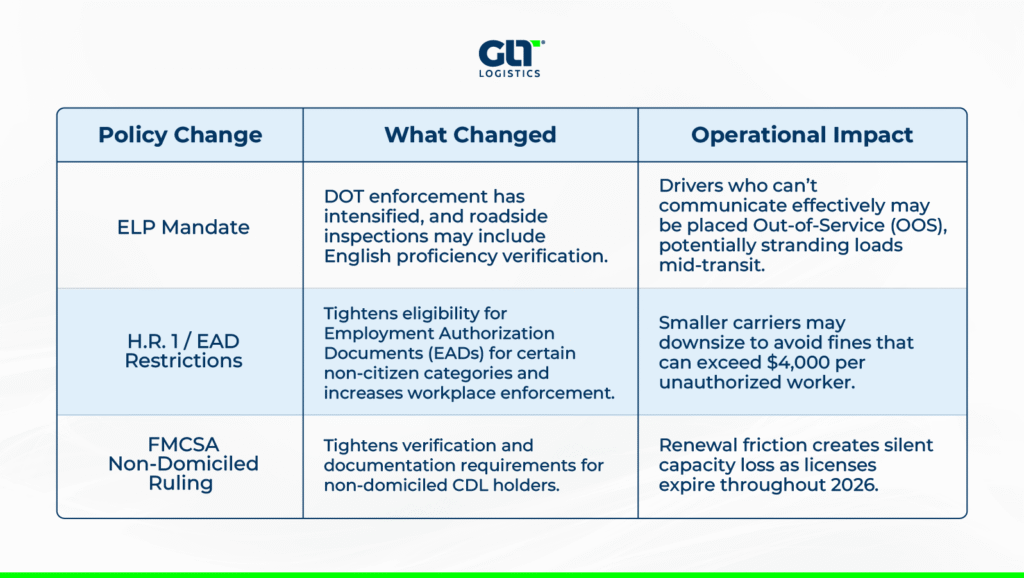
The question is how these conditions will impact day-to-day operations—and what you can do to protect service levels.
How Can Immigration Policies Impact Your Operations?
Although the full impact of these regulations will take definitive shape as existing licenses expire throughout 2026, early market signals already point to a challenging landscape:
1. Selective Contraction of the “Driver Pool”
Not all carriers will be affected equally. The hardest hit will be small carriers and owner-operators, a segment that historically relies heavily on non-domiciled CDL holders. These operators often serve as the “relief valve” of the spot market, taking loads that large asset-based carriers reject or covering difficult long-haul routes.
Early signals already point to tightening capacity on key border lanes (Laredo, El Paso, Otay Mesa), narrowing booking windows and forcing shippers to secure compliant coverage earlier. The effects are most visible in specific corridors, where capacity can vanish overnight.
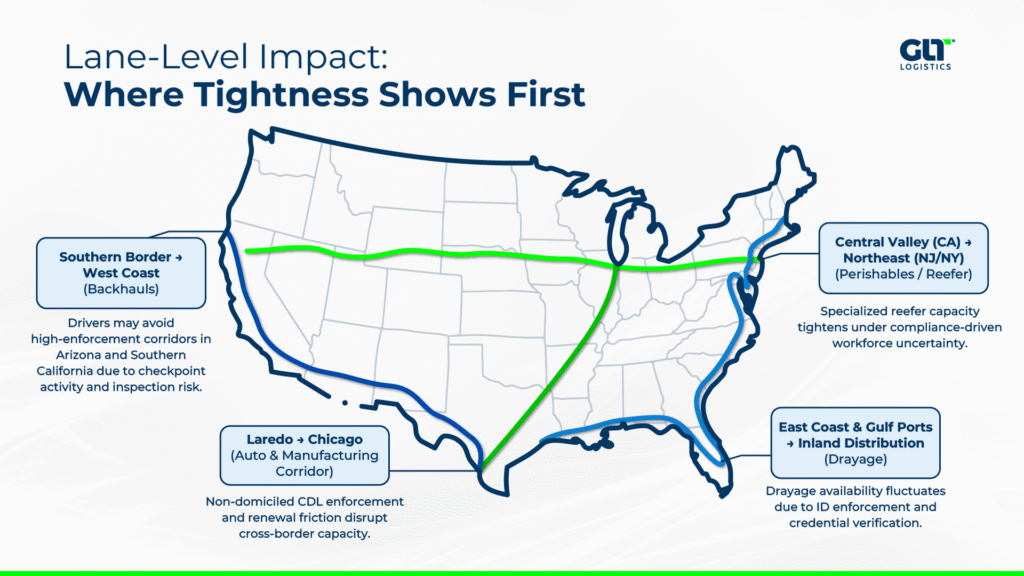
2. Carrier Stability and “Ghost Capacity”
Imagine having a truck confirmed for a Friday 4:00 PM pickup, only to find out the driver was disqualified that morning. Under these new conditions, a carrier may look operational on paper but lose its legal capacity overnight if its drivers fail to renew credentials under the new FMCSA rule, resulting in tender rejections, late cancellations, or failed coverage—even after a load is confirmed.
3. Rate Volatility: The “Risk Premium”
As highlighted in the Q1 2026 Freight Rate Report by U.S. Bank and DAT Freight & Analytics, the end of 2025 already signaled a structural shift in pricing dynamics.

DAT’s analysis shows that spot market rates—often the earliest indicator of changing market conditions—rose by an average of 10 cents per mile in Q4, a 4.8% increase over Q3. Over the second half of the year, spot rates advanced 6.2%, while contract rates posted a second consecutive quarter of growth (+1.4%).
Notably, shippers saw a decline in fuel outlays (down 2.9%), reinforcing a key point: the rise in transportation costs was not being driven by diesel prices alone. Instead, rates were increasingly reflecting a tightening capacity environment—where scarcity, compliance risk, and operational friction become embedded into pricing.
In this context, immigration-driven labor restrictions introduce a new variable into the market: a measurable reduction in eligible capacity. For shippers relying heavily on the spot market, this translates into a growing “risk premium” that can show up as faster rate swings, higher rejection risk, and less predictable coverage—even when fuel remains stable.
4. The New Compliance Burden
Compliance becomes a full-time operation, and that cost ultimately gets priced into the lane. You need systems that monitor not just the truck’s insurance, but the driver’s work authorization and credential eligibility.
How Can a 3PL Make Immigration Restrictions Easier for Your Business?
These immigration policies and restrictions translate into a critical need for strategy among logistics stakeholders. At GLT Logistics, our philosophy drives us to focus on one goal: ensuring the success and safety of every load, regardless of market complexity.
Here is how we help you navigate these challenges:
1. Predictive Intelligence to Protect Your Freight
Instead of just reacting to disruptions, we anticipate them. Our predictive alerts and antifraud intelligence allow us to vet carriers with forensic precision. We cross-reference eligibility and safety signals in real time to ensure the driver assigned to your load isn’t just “available” but compliant and capable of passing a DOT inspection.
2. Preferred Capacity in Critical Lanes
When the general “driver pool” shrinks, relationships matter more than algorithms. Since 2002, we have built strong ties with a network of reliable carriers. We offer rapid execution and preferred-carrier capacity for every critical load. Even when the spot market is tight, we have access to partners who prioritize our freight.
3. If We Quote It, We Move It
In a volatile market, we stand by our word. We honor every rate and commitment we make, prioritizing long-term reliability over short-term fluctuations. As accountability is our language, we take ownership of the process, resolve any disruptions, and ensure your freight keeps moving.
By partnering with a 3PL that prioritizes compliance, communication, safety, and proactive planning, you turn a market challenge into a competitive advantage, allowing you to focus on your core operations.
If you want to assess how these changes may impact your lanes and coverage strategy, our team can help. Please feel free to reach out to us here to discuss coverage strategies for your key lanes.