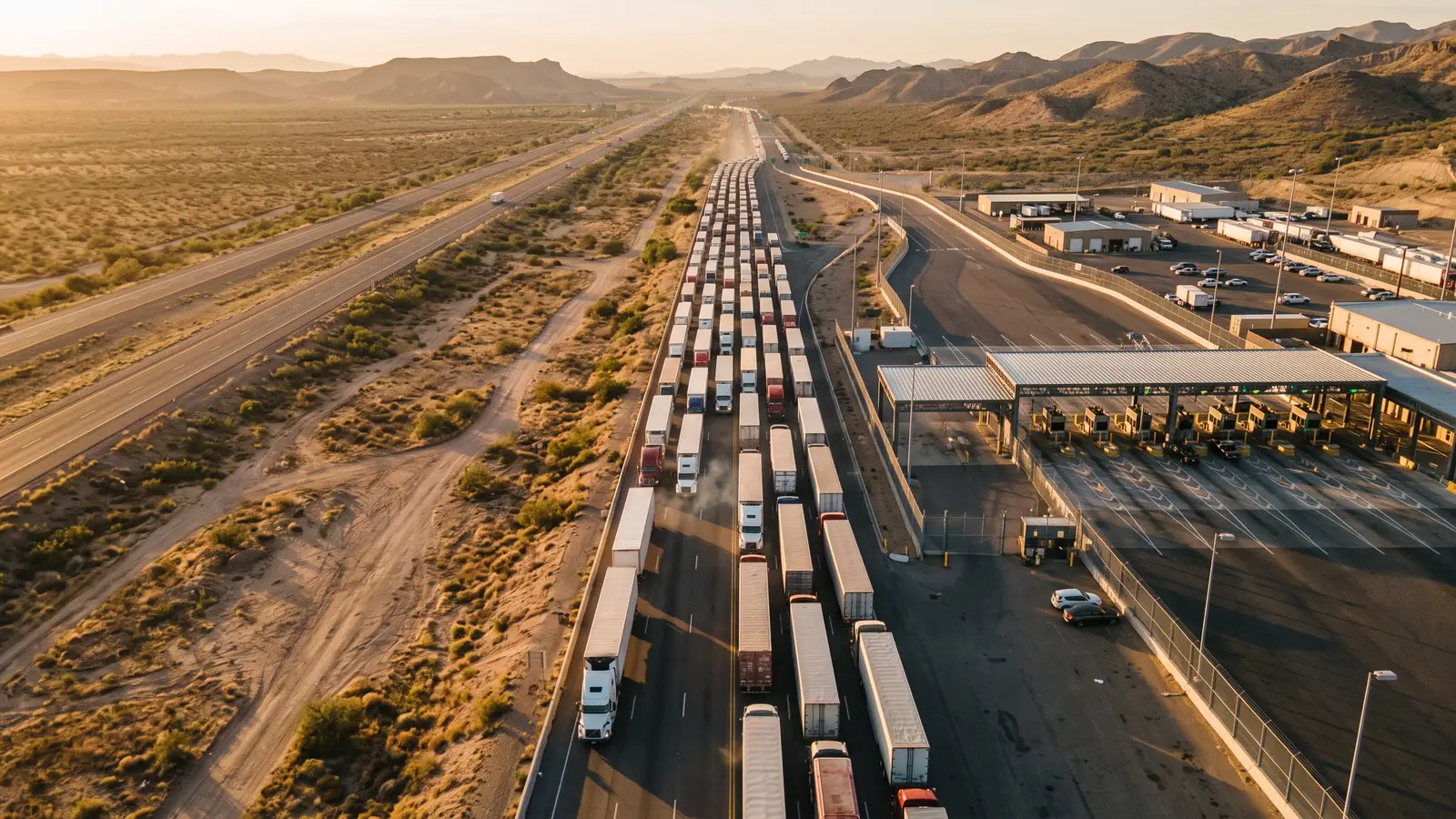
US-Mexico cross-border freight capacity has tightened for 11 straight months, and the squeeze doesn’t look the same at every crossing. Mexican exports grew 37.9% year over year in September, and nearshoring keeps adding northbound volume. Laredo actually has more available trucks than it did a few months ago, while El Paso and the Tijuana-San Diego corridor are tighter. A one-day truckers’ strike across 19 Mexican states on October 26 added a short-term shock on top of that imbalance.
If you move freight across the border, a single national capacity number won’t tell you much. You need lane-by-lane visibility instead.
Spot and contract rates are both climbing at the same time, which rarely happens together. That combination tells you capacity is leaving the market faster than demand is, not just shifting between pricing models. For shippers and forwarders working Mexico lanes, the next few months reward teams that plan ahead instead of chasing trucks at the last minute.
What’s Happening to US-Mexico Cross-Border Freight Capacity Right Now
US-Mexico cross-border freight capacity has contracted for 11 consecutive months, according to the Logistics Managers’ Index. The Transportation Capacity Index read 38 in October 2026, down from 54.5 a year earlier. Spot rates are up nearly 47% year over year, and contract rates are up almost 20% — both signs trucks are leaving the market.
Diesel prices above $6 a gallon, up 71% year over year, add to the pressure. Carriers also posted a 13.5% tender rejection rate in October, compared with 5.73% a year earlier. A higher rejection rate means carriers are turning down more loads because they have better options elsewhere.
None of this is unique to Mexico lanes. But Mexico-bound freight sits inside a national capacity squeeze and a regional one at the same time. That’s why the rest of this guide breaks the border into its separate pieces instead of treating it as one market.
Why Nearshoring Is Squeezing Capacity in Both Directions
Nearshoring keeps adding freight to Mexico-US lanes faster than carriers can add capacity. Mexican exports rose 37.9% year over year in September, and imports rose 33.1%, according to C.H. Robinson’s November 2026 freight market update. Northern and central Mexico now move far more freight northbound than southbound, which leaves fewer trucks positioned to carry outbound loads.
When a region sends out more trailers than it brings in, carriers get selective. They hold out for better-paying freight instead of repositioning empty. You feel that as longer lead times and higher rates on the lanes everyone wants.
The Bajío region in north-central Mexico is an exception. Freight flows there are more balanced. C.H. Robinson is explicit that balanced flow doesn’t mean loose capacity or falling rates in that region either.
Capacity Looks Different at Every Border Crossing
Laredo, El Paso, Nogales, and the Tijuana-San Diego corridor are not facing the same squeeze. Laredo’s truck availability has actually improved on the U.S. side. El Paso is more constrained and prone to short, sharp capacity spikes. Nogales is absorbing extra pressure from Mexican produce season, and Tijuana-San Diego capacity is tighter because of higher Asia-origin ocean import volumes.
| Crossing | Current Condition | What’s Driving It |
|---|---|---|
| Laredo, TX | Improved truck availability | Still the largest export corridor, but not currently the tightest |
| El Paso, TX | Constrained, prone to spikes | Short lead times create the sharpest pressure |
| Nogales / Tucson, AZ | Building pressure | Produce season competes with manufacturing freight for trucks |
| Tijuana / San Diego, CA | Tighter capacity | Higher ocean import volumes from Asia pull trucks elsewhere |
| Bajío (north-central Mexico) | More balanced flows | Balance here doesn’t mean loose capacity or falling rates |
This matters for routing decisions. A load that’s hard to cover out of El Paso this week might move easily through Laredo, and the reverse is just as possible next month. Working with a partner who has carrier relationships across more than one crossing gives you options the spot market alone won’t.
The October Truckers’ Strike Added a Short-Term Shock
A one-day truckers’ strike on October 26 spread across 19 Mexican states, with the heaviest disruption around Mexico City. C.H. Robinson reported localized congestion and transit delays, but no broad shutdown of the freight network. The impact was real but contained.
Strikes and blockades aren’t new on Mexico lanes, and they tend to be short. The bigger risk isn’t the strike itself. It’s getting caught without a backup plan when one hits during an already tight capacity market.
Driver Visa Enforcement Is Tightening the Labor Pool Too
U.S. authorities have stepped up cabotage enforcement against Mexican truck drivers. Cabotage means hauling freight between two U.S. points without proper authorization, something a cross-border B-1 visa doesn’t allow under FMCSA’s Mexico long-haul program rules. Enforcement has driven thousands of visa revocations, shrinking the pool of drivers available for legitimate cross-border runs.
U.S. Transportation Secretary Sean Duffy said roughly 3,200 Mexican commercial drivers have had visas revoked since January for cabotage violations. Canacar, a Mexican trucking group, cites a larger figure, around 20,000, over a longer stretch dating back to April 2025. Mexico already has an estimated driver shortage of about 96,000, according to Canacar, so pulling drivers out of service on top of that adds more pressure to a market that’s already short on trucks.
The exact numbers vary by source and by what each one is counting, so treat them as directional rather than precise. The trend they point to is consistent: fewer available Mexican drivers serving U.S. lanes, legally or otherwise.
What Rising Spot and Contract Rates Mean for Shippers
Van spot rates hit $3.05 a mile in October, the highest monthly average since February 2022, according to DAT Freight & Analytics. Contract rates climbed to $3.28 a mile, matching a record set in May 2022. Both are rising together, which signals a real capacity shortage rather than a seasonal blip.
When spot and contract rates move up at the same time, shippers lose their usual relief valve. You can’t just shift freight from one pricing model to the other to dodge the increase. The lever left is how far ahead you plan and how flexible your routing is.
Shippers moving freight into and out of Mexico get more value from a partner that can shift a load between crossings, equipment types, and modes than from chasing the lowest spot quote. Capacity gaps close fast when you have more than one lane option.
How to Protect Your Freight Before Year-End
You can reduce your exposure to Mexico capacity swings with a few concrete steps: book time-sensitive loads further ahead, diversify the crossings you use, confirm your carriers’ CTPAT status, and keep a buffer day on anything tied to a hard deadline.
- Book full truckload and LTL capacity into Mexico at least 5-7 days ahead through year-end.
- Compare conditions at more than one crossing before committing to a single route.
- Confirm carrier CTPAT status to reduce border wait times.
- Build a 1-2 day buffer into deadline-sensitive shipments.
- Review your cargo insurance coverage before a high-value or temperature-sensitive load crosses the border.
- Ask your 3PL for real-time visibility into your shipment, not just a rate quote.
A carrier network built around CTPAT-certified, owner-operated trucks (CBP’s CTPAT program) typically clears the border faster than one that isn’t. That time savings behaves like extra capacity when trucks are scarce.
FAQ — US-Mexico Cross-Border Freight Capacity
Border conditions will keep shifting between now and year-end. The shippers who stay ahead of it are the ones with visibility into more than one crossing and more than one equipment type, not the ones watching a single spot rate.
GLT Logistics has moved freight across the US-Mexico border for more than 23 years, with a bilingual team and a carrier network of CTPAT-certified, owner-operated trucks that are personally vetted before they haul a load. That track record is what lets GLT shift freight between crossings when one tightens, instead of waiting out the market. You can see the full scope of coverage, from LTL to container drayage, on GLT’s Mexico Freight Services page.
That network covers full truckload capacity and less-than-truckload shipments across the border, with 98% LTL coverage in Mexico and real-time visibility on every load. For high-value freight crossing a tighter corridor, pairing that with the right cargo insurance coverage is worth the extra five minutes.
Ready to Move Freight Across the Border With Fewer Surprises?
Talk directly with a bilingual logistics team that tracks Mexico capacity crossing by crossing — not a chatbot, not a junior rep.
No commitment. Just a real conversation about your freight.